
Nov 8, 2026
Following the release of the H1’2026 results by Kenyan insurance firms, the Cytonn Financial Services Research Team undertook an analysis on the financial performance of the listed insurance companies and the key factors that drove the performance of the sector. In this report, we assess the main trends in the sector, and areas that will be crucial for growth and stability going forward, seeking to give a view on which insurance firms are the most attractive and stable for investment. As a result, we shall address the following:
- Insurance Penetration in Kenya,
- Key Themes that Shaped the Insurance Sector in H1’2026,
- Interest rates
- Industry Highlights and Challenges,
- Performance of The Listed Insurance Sector in H1’2026, and,
- Conclusion & Outlook of the Insurance Sector.
Section I: Insurance Penetration in Kenya
Insurance uptake in Kenya remains low compared to other key economies, with insurance penetration coming in at 2.5%, according to Atlas Magazine. The low penetration rate, which is below the global average of 7.2%, according to the Allianz Global Insurance Report 2026, is attributable to the fact that insurance uptake is still seen as a luxury and mostly taken only when it is necessary or a regulatory requirement. Notably, insurance penetration growth declined by 0.2% points to 2.5% from 2.7% recorded in H1'2025, as the industry’s gross premium grew 20.4% to Kshs290.6 bn in H1'2026, from Kshs241.3 bn in H1'2025. The chart below shows Kenya’s insurance penetration for the last 15 years: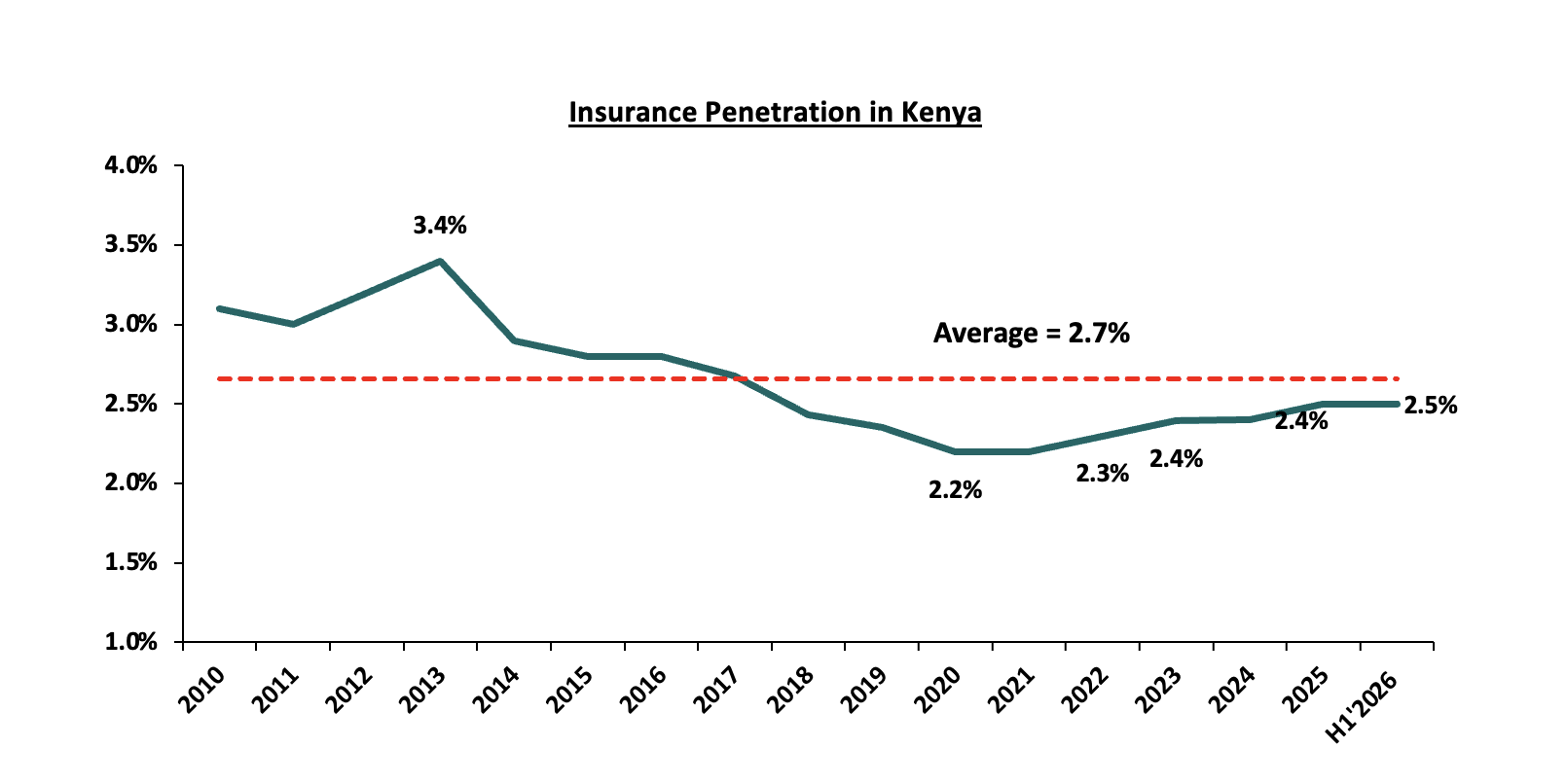
Source: Cytonn Research
The chart below shows the insurance penetration in other economies across Africa: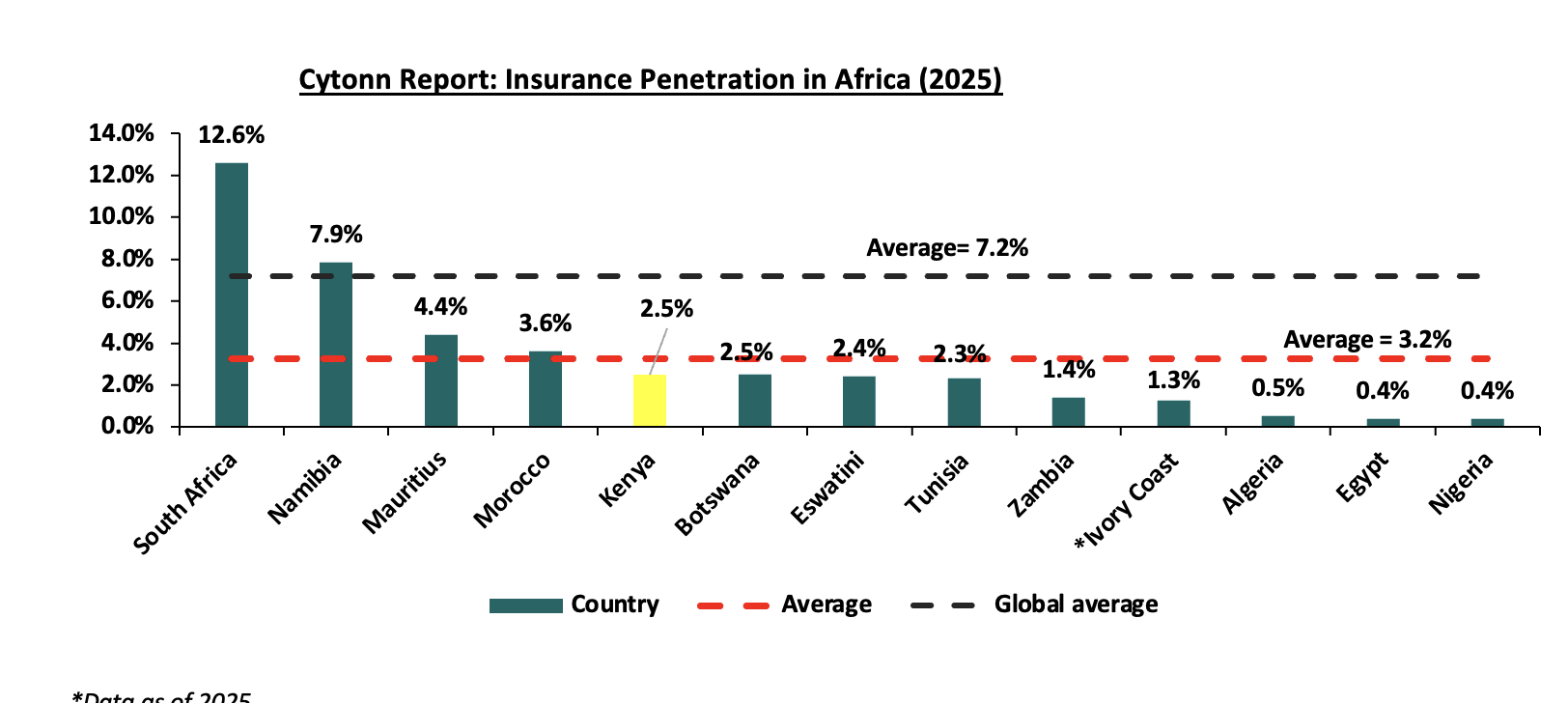
*Data as of 2025
Source: Atlas Magazine
Insurance penetration in Africa has remained relatively low, averaging 3.2% in h1’2026. The below average figures indicate that while digital transformation and product innovation are advancing, they have not yet overcome structural barriers like low disposable income, limited awareness, and skepticism about insurers. South Africa remains the leading in the continent, but most of the continent continues to grapple with underinsurance, leaving households and businesses vulnerable to shocks as the gap between Africa and the rest of the world remans wide.
Section II: Key Themes that Shaped the Insurance Sector in H1’2026
In H1’2026, Kenya’s macroeconomic conditions tightened, with inflation picking up and the Shilling weakening against the dollar. Notably, the inflation rate in H1’2026 averaged 5.3%, 1.6% points higher than the 3.7% average in H1’2025, with the Kenyan Shilling having depreciated by 20.5 bps against the USD to Kshs 129.5 from Kshs 129.2 in H1’2025. As such, according to the Q2'2026 Insurance Regulatory Authority Insurance Industry Release, the insurance sector showcased resilience recording a 20.4% growth in gross premium to Kshs 290.6 bn in H1'2026, from Kshs 241.3 bn in H1'2025. Insurance claims also increased by 7.4% to Kshs 132.0 bn in H1'2026, from Kshs 122.9 bn in H1'2025.
On the other hand, the overall GDP growth rate improved to 5.1% in Q2’2026, from 4.9% recorded in a similar period last year according to Q2’2026 Quarterly Gross Domestic Product Report. Higher economic growth generally supports the insurance industry by increasing household incomes, business activity, and investment, which, in turn, boosts demand for insurance products and expands the industry's premium base. The strong performance of the insurance sector in H1'2026 therefore reflects resilient underlying economic growth, even as insurers had to navigate a tougher operating backdrop of elevated inflation and a weaker Shilling over the same period, underscoring the sector’s ability to grow premiums despite the broader macro environment.
Notably, premium income in H1'2026 compared to a 45.7% contribution in H1'2025, while general insurance business contributed 48.8% of the industry’s premium income compared to 53.8% in the same period. During the period, long-term insurance premiums increased by 33.6% to Kshs 147.5 bn from Kshs 110.4 bn in H1'2025, while general insurance premiums grew by 9.2% to Kshs 141.9 bn from Kshs 129.9 bn in H1'2025. Microinsurance premiums amounted to Kshs 1.2 bn, bringing the industry’s total gross premium income to Kshs 290.6 bn in H1'2026. Additionally, motor insurance and medical insurance classes of insurance accounted for 68.1% of the gross premium income under the general insurance business, compared to 67.6% recorded in H1'2025. As for long-term insurance business, the major contributors to gross premiums were deposit administration and life assurance class, accounting for 29.4% and 19.9% respectively in H1'2026, compared to the 54.8% combined contribution by the two classes in H1'2025.
Key highlights from the industry performance:
- The sector’s investment income declined in H1'2026 by 5.3% to Kshs 73.0 bn from Kshs 77.1 bn in H1'2025, mainly attributable to a 7.5% decrease in investment income under the long-term insurance business to Kshs 62.4 bn from Kshs 67.5 bn in H1'2025. The performance was however supported by a 10.3% increase in investment income under the general insurance business to Kshs 10.5 bn from Kshs 9.5 bn in H1'2025,
- Insurance uptake improved in H1'2026, with industry gross premiums increasing by 20.4% to Kshs 290.6 bn from Kshs 241.3 bn in H1'2025. The growth was driven by increased activity in both the long-term and general insurance segments, reflecting the sector’s resilience amid tightened macroeconomic conditions, marked by elevated inflation and a weaker Shilling during the period. Nevertheless, low insurance penetration and limited awareness of insurance products continue to constrain the industry’s growth potential.
- Enhanced convenience and operational efficiency driven by the continued diversification of distribution and premium collection channels, including bancassurance, digital platforms, and strengthened agency networks. Partnerships between insurers and both banks and telecommunications companies have deepened in H1'2026, with players such as Britam, CIC, Jubilee, and Sanlam leaning further into mobile and digital channels to cut distribution costs and reach previously underserved segments. Safaricom’s continued push into insurance distribution adds another layer to this shift, positioning telco infrastructure as a genuine alternative to the branch-and-agent model that has traditionally defined how Kenyans buy cover, and
- Rising smartphone penetration is quietly becoming a distribution channel in its own right for insurers. Financing schemes such as “Lipa Mdogo Mdogo,” which let consumers acquire smartphones through instalment plans stretching up to twelve months, continue to push device ownership higher across income segments that previously found smartphones out of reach. As more Kenyans come online through these financing models, insurers gain a growing pool of potential customers reachable through mobile premium payments, policy servicing, and embedded insurance products bundled directly into digital ecosystems, presenting insurers an opportunity to design device, health, and microinsurance products tailored to first-time insurance buyers discovering cover through their phones rather than an agent.
On valuations, listed insurance companies are trading at a price to book (P/Bv) of 1.0x, lower than listed banks at 1.3x, but both are lower than their 20-year historical averages of 1.3x and 1.6x, for the insurance and banking sectors respectively. These two sectors are attractive for long-term investors supported by the strong economic fundamentals. The chart below shows the price to book comparison for Listed Banking and Insurance Sectors: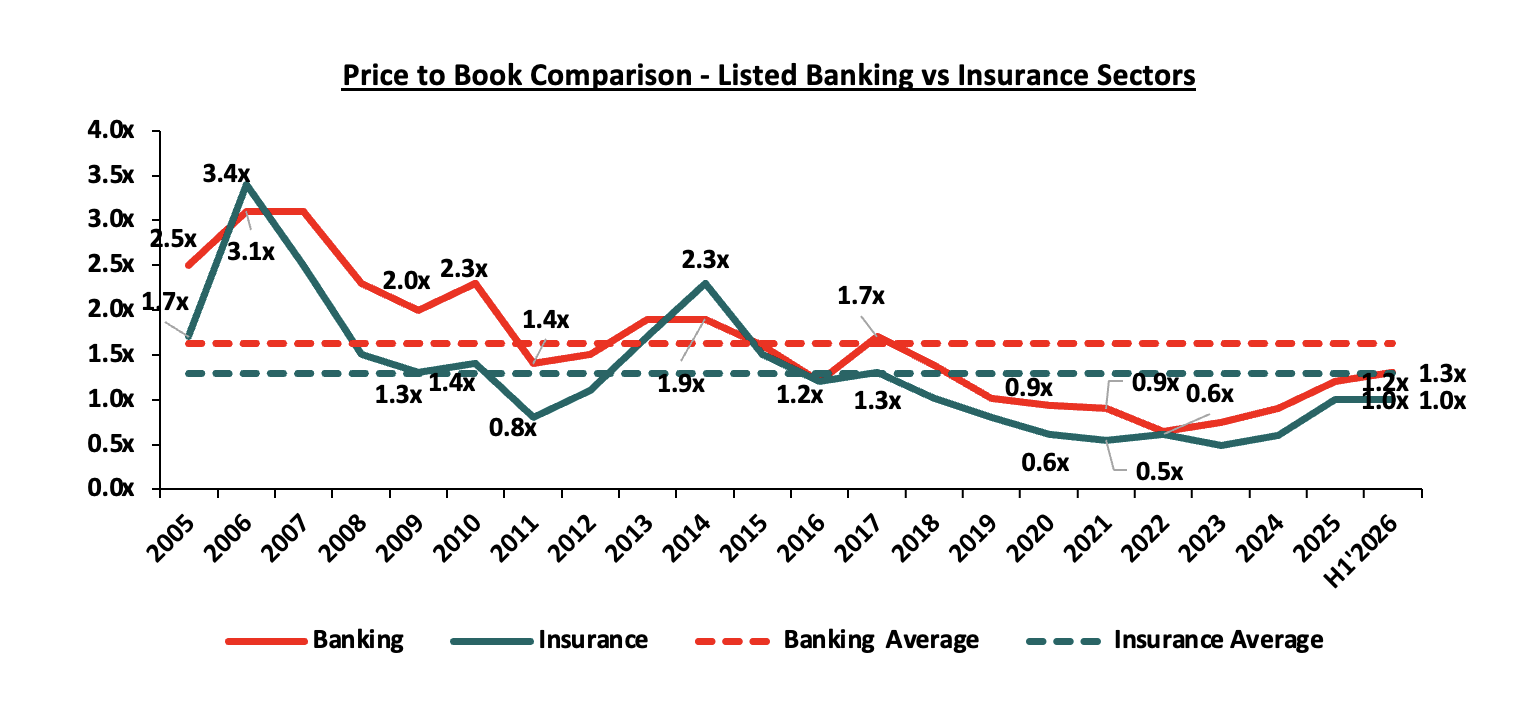
Source: Cytonn Research
The key themes that have continued to drive the insurance sector include:
- Technology and Innovation
The Kenyan insurance industry’s embrace of AI deepened further in H1'2026, moving from isolated pilots toward tools now handling claims at scale. Britam General Insurance launched its AI Motor Assessment Service in March 2026, a drive-through facility that uses AI to assess accident damage via photographs and settle minor motor claims within two hours, down from the industry’s typical five-day turnaround, while also screening for fraud by verifying image authenticity and flagging inconsistent damage claims. On the fraud detection front specifically, Smart Applications International Unveiled Smart Detect AI in May 2026, a platform using machine learning, behavioural analytics, and clinical logic to flag suspicious healthcare claims before and after submission, giving insurers earlier visibility into hidden risks at a time when industry estimates put fraud prevalence as high as 20% of total claims. IRA also advanced regulatory sandboxes and tighter digital insurance guidelines to ensure oversight evolves alongside AI-driven underwriting and claims automation. Collectively, these developments suggest the industry’s digital shift, once driven by a handful of first-mover products, is now reinforced by purpose-built fraud detection tools and a regulator actively building the rules to match, pointing to AI becoming a permanent rather than experimental feature of how Kenyan insurance is distributed, serviced, and policed against abuse.
- Regulation
To position the sector within a globally competitive financial services landscape, the regulator has been actively implementing regulations aimed at tackling both longstanding and emerging challenges. The COVID-19 environment proved challenging especially on the regulatory front, as it was a balance between remaining prudent as an underwriter and adhering to the set regulations given the negative effects the pandemic. Regulations used for the insurance sector in Kenya include the Insurance Act Cap 487 and its accompanying schedule and regulations, Retirement Benefits Act Cap 197 and The Companies Act. In H1’2026, regulation remained a key aspect affecting the insurance sector and the key themes in the regulatory environment include;
- IFRS 17- IFRS 17, Insurance Contracts, replaced IFRS 4 and became effective for annual periods beginning on or after 1st January 2023. The standard establishes the principle for recognition, measurement, presentation and disclosure of insurance contracts with the objective of ensuring insurance companies provide relevant information that faithfully represents the contracts. Kenyan insurers have now reported under the standard for multiple financial years, and the sustained rise in claims-driven combined ratios observed through FY’2024, FY’2025 and into H1'2026 continues to reflect, in part, the standard’s more granular recognition of insurance service expenses. The standard continues to give better information on profitability by providing more insights into the current and future profitability of insurance contracts. Separation of financial and insurance results in the income statement continues to allow for better analysis of core performance for the entities and better comparability of insurance companies,
- Risk Based Supervision - IRA has been implementing risk-based supervision through guidelines that require insurers to maintain a capital adequacy ratio of at least 200.0% of the minimum capital, with insurers falling below the 100.0% floor subject to regulatory intervention by the Authority. The risk-based capital requirement is derived by aggregating the capital charges for insurance risk, market risk and credit risk using the square root of the sum of their squares to account for diversification benefits, with the operational risk charge then added to arrive at the total requirement. This sits above hard capital floors set out in the Insurance Act, which require general insurers to hold the highest of Kshs 600.0 mn, the IRA-determined risk-based capital, or 20.0% of net earned premiums from the preceding financial year, while life insurers must hold the highest of Kshs 400.0 mn, the risk-based capital, or 5.0% of life business liabilities for the year. The regulation requires insurers to monitor capital adequacy and solvency margins on a quarterly basis, with the main objective being to safeguard the insurer's ability to continue as a going concern and provide shareholders with adequate returns. Looking ahead, the IRA is set to roll out Risk-Based Supervision Phase II, which will further tie capital held to actual risk exposure. We expect more mergers within the industry as smaller companies struggle to meet the minimum capital adequacy ratios. We also expect insurance companies to adopt prudential practices in managing and taking on risk and reduction of premium undercutting in the industry as insurers will now have to price risk appropriately.
- Mandatory Reinsurance Cessions to Kenya Re: The reinsurance cession framework flagged in the FY’2025 report has since been formally gazetted as the Insurance (Amendment) Regulations, 2025 (Legal Notice 55 of 2026), commencing 26 March 2026. The regulations require every insurer to submit copies of all general insurance reinsurance treaties, both existing and future, to Kenya Reinsurance Corporation, while long-term insurers must cede a prescribed share of every policy issued in Kenya to the Corporation on the basis set out in the regulations. Formalizing this requirement into law, rather than leaving it as a circular-level directive, strengthens the Corporation’s claim on industry cession flows and reduces insurers’ room to negotiate around it, continuing the regulator’s broader push to retain more domestic risk and premium within the local market rather than ceding it to foreign reinsurers.
- Capital Raising, M&A, and Corporate Restructuring
- Sanlam Allianz’s Rights Issue Reaches Its Conclusion: The IRA approved the final tranche of deferred shares from the 2025 rights issue in September 2026. The allotment expanded Sanlam Allianz Holdings’ issued share capital by 18.5%, from 543.4 million to 644.0 million shares, with the bulk of the unsubscribed rights absorbed directly by parent company Sanlam Allianz Africa (SAZ) in its capacity as underwriter. This has had an unintended regulatory consequence: SAZ’s stake has climbed to 71.47%, breaching the Insurance Act’s 66.67% cap on foreign ownership, forcing a mandated sell-down of 4.81% on the NSE by September 2027. The episode is a useful illustration of how capital raising initiatives, even when well-intentioned and compliance-driven, can create new regulatory friction when underwriting arrangements push ownership structures past statutory limits.
- Absa Exits Insurance Manufacturing in Kenya: Absa Group agreed to sell its entire 63.3% stake in both First Assurance Company Limited and Absa Life Assurance Kenya Limited to First Assurance Investments Limited for approximately Kshs 3.8 bn, conditional on IRA approval. The transaction effectively returns these assets to the same ownership network Barclays Africa originally bought out, now at a materially higher valuation than Kshs 2.9 bn paid at the time. The move fits a broader pattern among regional banking groups of retreating from capital-intensive insurance underwriting while retaining the more capital-light banking and distribution relationships, a trend worth watching given how much of the sector’s growth narrative has otherwise centred on banks deepening, rather than exiting, their insurance exposure through bancassurance.
- Sanlam Allianz Consolidates Its Life Insurance Structure: Sanlam Allianz Holdings announced plans to absorb its wholly-owned life subsidiary, Sanlam Allianz Life Insurance (Kenya) Limited, directly into the NSE-listed parent, transferring Kshs 38.5 bn in assets and collapsing a corporate layer that has existed since the group’s prior general insurance consolidation in 2025. The subsidiary will surrender its license and eventually dissolve, with the listed entity itself renamed Sanlam Allianz Life Insurance (Kenya) PLC pending shareholder approval. While this does not alter the group’s 2.9% share of the long-term insurance market, it reflects a broader push toward structural simplification across the group, aimed at reducing overhead and consolidating oversight rather than raising fresh capital or changing ownership.
- CAK Cleared First Chartered’s Full Takeover of ICEA Lion: The Competition Authority of Kenya authorized First Chartered Securities Capital to acquire sole control of ICEA Lion Insurance Holdings. The clearance paves the way for First Chartered, which already held 75.9% of ICEA Lion, to buy out the remaining 24.1% stake from Eastern Africa Holdings Limited, the Leapfrog-managed vehicle through which Prudential Financial held its interest. The regulatory sign-off effectively closes out Prudential’s five-year exposure to Kenyan insurance, after the US insurer agreed in January 2026 to exit the market entirely, and adds to a broader theme of foreign and institutional investors reassessing their exposure to Kenyan insurance manufacturing, even as the capital-intensive underwriting side sees ownership consolidate back toward founding shareholders.
D. Section III: Interest rates
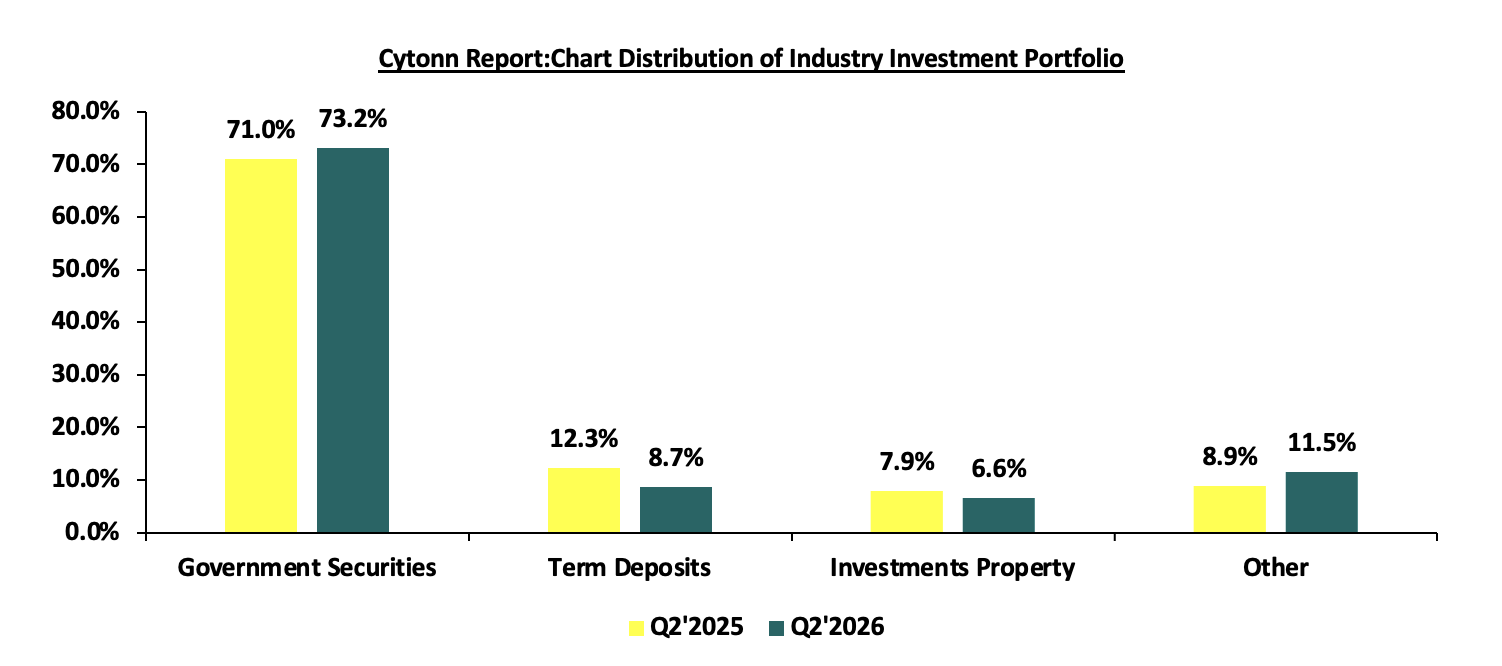
The interest rate environment has remained on a declining trend since FY’2025, and the insurance sector’s preference for government securities has only deepened as a result. Government securities now make up 78.4% Kshs 893.7 bn of long-term insurers’ investment portfolios in H1'2026, up 25.6% from Kshs 711.5 bn in H1'2025, and 58.8% Kshs 123.4 bn of general insurers’ portfolios, up 14.5% from Kshs 107.8 bn. Industry-wide, government securities holdings grew 23.3% to Kshs 1.1 tn, now accounting for 73.2% of the sector’s total Kshs 1.4 tn investment book. The sustained increase in holdings of government securities, even as yields moderate, reflects insurers’ continued preference for low-risk and liquid assets that are well suited to meeting policyholder obligations and matching long-term liabilities.
On the policy rate itself, the Central Bank of Kenya’s Monetary Policy Committee cut the Central Bank Rate (CBR) by 25.0 bps to 8.75% at its February 10, 2026 meeting. The Committee has since held the CBR unchanged at 8.75% across four consecutive meetings through October 2026, most recently at its October 7, 2026 meeting, as inflation crept up to 7.3% in October, within CBK’s target range of between 2.5%-7.5%. Private sector credit growth held firm at 10.6%. The extended hold, now stretching eight months since the February cut, signals the MPC’s preference to let prior easing work through the economy rather than risk reigniting inflationary pressure, even as insurers’ investment income growth continues to feel the lagged effect of lower yields locked in earlier in the cycle.
We expect the rate environment to continue weighing on insurers’ investment income growth into H2'2026, given the sector’s heavy skew toward government securities, which made up 78.4% of long-term insurers’ investments and 58.8% of general insurers’ investments as at H1'2026. On the liability side, the lower rate environment reduces the discount rates typically applied to actuarial liabilities and annuity or guaranteed-return products, which could push up reserving requirements for life insurers with rate-sensitive guarantees, further compressing the net benefit of the easing cycle to date. We expect insurers to keep favouring government securities given this dominant allocation, but with growing incentive to extend duration on new purchases to lock in still-elevated long-end yields before any resumption of easing, and to watch the MPC’s December 2026 meeting closely for signals on whether the current hold persists or gives way to either direction.
Source: IRA
Section IV: Industry Highlights and Challenges
The insurance sector has recorded consistent growth over the past ten years, though recent global uncertainties including the impact of regional conflicts and supply chain disruptions have introduced second guesses about the pace of expansion. Even so, the industry is expected to continue growing at a moderate rate, supported by Kenya’s improving economic fundamentals and a steady rise in insurance premiums, factors which are likely to enhance the sector’s capacity to maintain profitability.
On the regulatory front, the Finance Act, 2026, introduced several provisions with direct implications for insurers. The Act replaced the term “life insurance fund” with “statutory fund” across the Income Tax Act, aligning the tax framework more closely with the Insurance Act and broadening the tax base for insurance companies. It also removed the VAT exemption on payment processing, settlement, merchant acquiring, gateway, and aggregation services, subjecting digital premium collection channels to the standard 16% VAT rate effective July 1, 2026. While these reforms are intended to enhance revenue collection and harmonize fiscal and regulatory frameworks, they impose additional financial and administrative burdens on insurers, making regulatory compliance an increasingly important challenge for the industry.
Industry Challenges:
- Insolvency: A major challenge facing Kenya’s insurance industry is the financial instability and insolvency of key players. During H1'2026, IRA placed Corporate Insurance Company and KUSCCO Mutual Assurance Limited under statutory management, a move that reduced industry paid-up capital by Kshs 200.0 mn and Kshs 400.1 mn respectively. Separately, Star Discover Micro Insurance Limited was excluded from the Q2'2026 industry release entirely for failing to meet statutory reporting requirements, continuing a pattern of non-compliant insurers being dropped from official analysis. These interventions reflect broader structural problems within the sector, inadequate risk management practices, weak corporate governance, and exposure to unprofitable business lines, that continue to undermine consumer confidence and disrupt policyholders forced to seek alternative coverage.
- Insurance fraud: Insurance fraud is an intentional deceit performed by an applicant or policyholder for financial advantage. The problem persists particularly in medical and motor insurance, with industry estimates still indicating roughly one in every five medical claims is fraudulent. In H1'2026, 77 fraud cases were reported to the Insurance Fraud Investigation Unit,17 in April, 15 in May, and a sharp jump to 45 in June alone, the top categories being forgery. To curb these challenges, the industry has continued implementing artificial intelligence to detect and prevent fraud, with Britam launching an AI-powered motor claims assessment service in March 2026 and Smart Applications International Unveiling Smart Detect AI for healthcare claims fraud in May 2026.,
- High Market competition: Despite Kenya’s relatively low insurance penetration, the industry remains highly fragmented, with numerous insurers competing for a limited customer base across life, general, and microinsurance segments. Competition has intensified with non-traditional players, particularly banks and telecommunications companies, expanding into insurance distribution. Safaricom’s continued push into insurance distribution and Equity Group’s expansion through Equity Life Assurance have accelerated the convergence between the insurance, banking, and telecommunications sectors, compelling traditional insurers to innovate and diversify their products to retain market share. This competitive pressure has continued to drive product innovation: across H1'2026, IRA approved 42 new or repackaged insurance products across general insurance, long-term insurance, and microinsurance business lines, reflecting the industry’s ongoing efforts to remain competitive in a rapidly evolving market.
- Declining consumer confidence in the insurance industry: Consumer complaints against insurers remained a persistent challenge in H1'2026. IRA registered 354 complaints from policyholders and beneficiaries during the period, with general insurers accounting for 85.3% of complaints against long-term insurers’ 14.7%. Resolution rates stood at 42.1% for general insurance complaints and 57.7% for long-term insurance complaints, meaning a majority of general insurance complaints, and a meaningful share of long-term ones, remained unresolved within the period. Most complaints continue to relate to delayed or disputed claims settlements, policy interpretation, and other service delivery issues, experiences that continue to erode consumer trust and slow the uptake of insurance products,
- Macroeconomic Uncertainty Global conflicts, commodity price volatility, and supply chain disruptions have created a fragile economic outlook. For insurers, this translates into unpredictable investment returns and slower premium growth. The uncertainty makes long‑term planning more difficult, forcing companies to adopt conservative strategies while still trying to meet growth targets, and,
Section V: Performance of the Listed Insurance Sector in H1’2026
The table below highlights the performance of the listed insurance sector, showing the performance using several metrics, and the key take-outs of the performance.
|
Listed Insurance Companies H1’2026 Earnings and Growth Metrics |
|||||||||
|
Insurance |
Core EPS Growth |
Insurance revenue growth |
Claims growth |
Loss Ratio |
Expense Ratio |
Combined Ratio |
ROaE |
ROaA |
|
|
CIC |
70.3% |
17.8% |
18.9% |
95.8% |
95.8% |
191.5% |
4.3% |
1.3% |
|
|
Britam |
56.7% |
13.7% |
30.7% |
76.8% |
57.0% |
133.7% |
7.7% |
1.2% |
|
|
Jubilee Insurance |
12.7% |
1.2% |
4.6% |
92.2% |
42.8% |
135.0% |
6.1% |
1.4% |
|
|
Sanlam |
(7.4%) |
1.1% |
9.2% |
85.1% |
41.3% |
126.4% |
2.9% |
0.3% |
|
|
Liberty |
(46.0%) |
99.1% |
(14.9%) |
58.1% |
63.6% |
121.7% |
2.3% |
0.5% |
|
|
*H1'2026 Weighted Average |
38.2% |
14.7% |
18.1% |
83.3% |
60.7% |
144.1% |
6.4% |
1.2% |
|
|
**H1'2025 Weighted Average |
(6.6%) |
13.7% |
19.8% |
85.2% |
102.5% |
187.7% |
5.6% |
1.3% |
|
|
*Market cap weighted as at 06/11/2026 **Market cap weighted as at 06/10/2025 |
|
||||||||
The key take-outs from the above table include;
- Core EPS growth recorded a significant weighted increase of 38.2% in H1’2026, from the weighted decline of 6.6% recorded in H1’2025. The increase in earnings was largely supported by the decrease in the expense ratio to 60.7% in H1’2026, from 102.5% in H1’2025,
- Insurance revenue grew at 14.7% in H1’2026, compared to a growth of 13.7% in H1’2025, while claims growth decreased marginally to 18.1% in H1’2026, compared to 19.8% growth recorded in H1’2025 on a weighted average basis,
- The loss ratio across the sector decreased to 83.3% in H1’2026, from 85.2% in H1’2025,
- The expense ratio decreased to 60.7% in H1’2026, from 102.5% in H1’2025, pointing to increased operating efficiency across the sector,
- The insurance core business remained unprofitable, with the combined ratio decreasing to 144.0% as at H1’2026, from 187.7% in H1’2025, and,
- On average, the insurance sector delivered a Return on Average Equity (ROaE) of 6.4%, an increase from a weighted Return on Average Equity of 5.6% in H1’2026, even as Return on Average Assets (ROaA) declined to 1.2% in H1’2026, from 1.3% in H1’2025.
Based on the Cytonn H1’2026 Insurance Report, we ranked insurance firms from a franchise value and from a future growth opportunity perspective with the former getting a weight of 40.0% and the latter a weight of 60.0%.
For the franchise value ranking, we included the earnings and growth metrics as well as the operating metrics shown in the table below in order to carry out a comprehensive review:
|
Listed Insurance Companies H1’2026 Franchise Value Score |
||||||
|
Insurance Co. |
Loss Ratio |
Expense Ratio |
Combined Ratio |
Tangible Common Ratio |
Franchise Value Score |
Ranking |
|
Liberty Holdings |
58.1% |
63.6% |
121.7% |
18.3% |
15 |
1 |
|
Jubilee Holdings |
92.2% |
42.8% |
135.0% |
19.8% |
17 |
2 |
|
Britam Holdings |
76.8% |
57.0% |
133.7% |
12.9% |
17 |
2 |
|
CIC Group |
95.8% |
95.8% |
191.5% |
13.6% |
20 |
4 |
|
Sanlam Kenya |
85.1% |
41.3% |
126.4% |
10.7% |
21 |
5 |
|
* H1’2026 Weighted Average |
83.3% |
57.8% |
141.1% |
15.4% |
|
|
The Intrinsic Valuation is computed through a combination of valuation techniques, with a weighting of 40.0% on Discounted Cash-flow Methods, 35.0% on Residual Income and 25.0% on Relative Valuation. The overall H1’2026 ranking is as shown in the table below:
|
Listed Insurance Companies H1’2026 Comprehensive Ranking |
|||||
|
Insurance Co. |
Franchise Value Score |
Intrinsic Value Score |
Weighted Score |
H1'2026 Ranking |
H1'2025 Ranking |
|
Britam Holdings |
2 |
1 |
1.4 |
1 |
5 |
|
Liberty Holdings |
1 |
2 |
1.6 |
2 |
3 |
|
Jubilee Holdings |
2 |
3 |
2.6 |
3 |
2 |
|
CIC Group |
4 |
4 |
4.0 |
4 |
1 |
|
Sanlam Kenya |
5 |
5 |
5.0 |
5 |
4 |
Major Changes from the H1’2026 Ranking are;
- Britam Holdings improved to position 1 in H1'2026, from position 5 in H1'2025, driven by a strengthened franchise score,
- Liberty Holdings improved to position 2 in H1'2026, from position 3 in H1'2025, supported by a strong improvement in underlying underwriting performance as the insurance service result nearly doubled, up 99.0% to Kshs 448.0 mn,
- Jubilee Holdings declined to position 3 in H1'2026, from position 2 in H1'2025, weighed down by a weakened franchise score as the insurance service result fell 60.0% to Kshs 445.0 mn amid high claims and rising medical costs in the health insurance segment,
- CIC Group declined to position 4 in H1'2026, from position 1 in H1'2025, driven by a weakened franchise score as underwriting profit declined during the period, with the 70.3% growth in profit after tax to Kshs 1.1 bn driven mainly by investment gains rather than improved underwriting performance, and,
- Sanlam Allianz Kenya declined to position 5 in H1'2026, from position 4 in H1'2025, driven by a weakened franchise score as profit before tax from continuing operations fell 28.0% to Kshs 201.0 mn on higher claims and lower investment returns, with the 32.0% growth in gross written premiums insufficient to offset the margin pressure during the period.
Section VI: Conclusion & Outlook of the Insurance Sector
Kenya’s insurance industry navigated a more challenging macroeconomic backdrop in H1'2026 compared to the prior year. Inflation averaged 5.3%, up from 3.7% in H1'2025, though it remained within the Central Bank of Kenya’s target range of 2.5%-7.5%, while the Kenyan Shilling depreciated by 20.5 bps against the US Dollar over the same period. The Monetary Policy Committee cut the Central Bank Rate by 25.0 bps to 8.75% in February 2026 before holding it unchanged across four consecutive meetings through October 2026, a stance that has continued to weigh on insurers’ investment income even as the broader economy expanded, with GDP growth improving to 5.1% in Q2'2026 from 4.9% a year earlier. Despite this tougher operating environment, the sector demonstrated clear resilience, with industry gross premiums growing 20.4% to Kshs 290.6 bn and the sector-wide combined ratio improving markedly to 144.1% from 187.7% in H1'2025, driven primarily by a sharp reduction in the expense ratio to 60.7% from 102.5%. However, insurance penetration remains low at 2.5% in H1’2026, underscoring the significant untapped market potential that persists despite the sector’s improved underwriting discipline. Going forward, insurers that strengthen consumer trust, improve operational efficiency and develop affordable, customer-centric products will be better positioned to capitalize on the sector’s long-term growth opportunities.
The outlook for the insurance industry remains positive, supported by structural growth opportunities across retail insurance, health insurance, digital distribution and regional expansion. The increasing adoption of technology, changing consumer behaviour and growing demand for financial protection products are expected to reshape how insurers design, distribute and price insurance solutions. To sustain growth and improve profitability, insurers will need to focus on the following strategic priorities:
- Rebuilding customer confidence through better claims handling: Consumer confidence continues to be a defining factor in how quickly insurance uptake can grow across the market. Despite strong premium growth, IRA registered 354 complaints in H1'2026 alone, with resolution rates of just 42.1% for general insurance and 57.7% for long-term insurance, meaning a majority of complaints, particularly those tied to delayed or disputed claims settlements, remained unresolved within the period. Insurers will need to enhance transparency, simplify policy wording, improve claims turnaround times and adopt customer-centric approaches to rebuild trust and encourage greater voluntary uptake of insurance products.
- Deepening digital adoption to widen insurance reach: Reaching underserved and informal market segments is increasingly being driven by how far insurers can push their digital capabilities. The period saw AI move from isolated pilots toward tools handling claims at scale, exemplified by Britam’s AI Motor Assessment Service, which settles minor motor claims within two hours, and Smart Applications International’s Smart Detect AI platform for healthcare fraud detection. Continued partnerships with fintechs, mobile network operators and digital platforms, alongside IRA’s advancement of regulatory sandboxes, will provide further opportunities to distribute affordable microinsurance and usage-based insurance products at scale.
- Diversifying investment portfolios beyond Government Securities - Insurers’ heavy reliance on a single asset class is becoming harder to justify as the rate cycle turns. With government securities now accounting for 73.2% of the industry’s Kshs 1.4 tn investment book, even as yields moderate in a declining rate environment, insurers face growing pressure to diversify beyond their traditional concentration in government paper. Exploring alternative investments, including infrastructure, climate-related assets and other long-term development financing vehicles, can help insurers enhance investment returns while reducing the sector’s vulnerability to the lagged effects of monetary easing on income from fixed-income holdings.
- Strengthening Governance and Risk Oversight Amid Evolving Regulation: The regulatory environment showed no signs of standing still in H1'2026, with fresh rules and enforcement action adding to the sector’s compliance load. The formal gazettement of the Insurance (Amendment) Regulations, 2025 tightened mandatory reinsurance cessions to Kenya Reinsurance Corporation, while IRA’s statutory management interventions at Corporate Insurance Company and KUSCCO Mutual Assurance Limited underscored persistent governance and solvency risks within the sector. Insurers will need to strengthen governance frameworks, improve capital management ahead of the IRA’s planned Risk-Based Supervision Phase II, and adopt stronger enterprise risk management practices to remain resilient and competitive.
- Designing Products Around Untapped Consumer Segments: Several underserved segments, among them health, agriculture, climate risk, retirement and small business cover, continue to represent untapped room for growth. With long-term insurance overtaking general insurance as the largest contributor to industry premium in H1'2026, driven heavily by deposit administration and life assurance classes, insurers that develop affordable and relevant products across both life and general lines will be better positioned to capture new market segments.
- Pursuing Growth Beyond Kenya’s Borders: Beyond its borders, Kenya’s standing as East Africa’s financial hub keeps opening doors for insurers looking to diversify away from a single domestic market. Expanding into underserved markets across Africa, where insurance penetration averaged just 3.2% in H1'2026, well below the global average of 7.2%, can help insurers reduce concentration risk while benefiting from rising demand for risk management solutions as economies continue to develop.
Overall, Kenya’s insurance sector continues to show meaningful room for growth, and the sharp improvement in underwriting discipline seen in H1'2026, reflected in the combined ratio’s decline to 144.1% from 187.7% in H1'2025, is an encouraging signal even as the sector’s core business remains unprofitable on an underwriting basis alone. Unlocking the sector’s full potential will still require a continued shift away from traditional insurance models toward more accessible, technology-driven and customer-focused solutions. The insurers that successfully close trust gaps, embrace innovation and diversify their sources of growth will be best positioned to capture the long-term opportunities presented by the evolving insurance landscape.
Disclaimer: The views expressed in this publication are those of the writers where particulars are not warranted. This publication is meant for general information only and is not a warranty, representation, advice or solicitation of any nature. Readers are advised in all circumstances to seek the advice of a registered investment advisor.

- Talk to us
- Kenya
- P.O Box 20695 - 00200, Nairobi, Kenya
- Cell +254709101200
- Tel +254709101200
- WhatsApp +254741676635
- United States
- +254709101200
- DOWNLOAD OUR APP
-


- Kenya
- 8th Floor, Pinetree Plaza, Kaburu Drive, Ngong Road, Nairobi, Kenya
- USA
- Suite 1150, 1775 Eye Street NW, USA, Washington DC 20006, USA
- Investments
- High Yield
- Private Equity
- Real Estate
- Real Estate
- RiverRun Estates
- Cytonn Towers
- The Ridge
- Taraji Heights
- The Alma