
Jun 28, 2026
On 11th June 2026, the National Treasury presented Kenya’s FY’2026/2027 National Budget to the National Assembly highlighting that the total budget estimates for FY’2024/25 increased by 3.9% to Kshs 4.8 tn from the Kshs 4.6 tn in FY’2025/2026 revised estimates, while the total revenue inclusive of grants increased by 6.8% to Kshs 3.7 tn from the Kshs 3.4 tn in FY’2025/2026 revised estimates . The increase is mainly due to an 7.2% increase in ordinary revenue to Kshs 3.0 tn for FY’2026/2027, from the Kshs 2.9 tn in FY’2025/26 revised estimates.
The FY’2026/2027 budget focuses mainly on providing solutions to the heightened concerns on the high cost of living, the measures put in place to stimulate sustainable economic recovery as well as undertaking a growth-friendly fiscal consolidation to preserve the country’s debt sustainability. Notably, the government projects to narrow the fiscal deficit to 5.5% of GDP in FY’2026/27, from the estimate of 6.4% of GDP in FY’2025/26 revised estimates. As such, this week, we shall discuss the recently released budget and the Finance Act 2026 with a key focus on Kenya’s fiscal components. We shall do this in four sections, namely:
- FY’2025/2026 Budget Outturn as at May 2026,
- Comparison between FY'2026/2027 and FY'2025/2026 Budget estimates,
- Analysis and House-view on Key Aspects of the 2025 Budget,
- Finance Act 2026, and,
- Conclusion and Our View.
Section I: FY’2025/2026 Budget Outturn as at May 2026
The National Treasury gazetted the revenue and net expenditures for the eleventh month of FY’2025/2026, ending 29th May 2026, highlighting that the total revenue collected as at the end of May 2026 amounted to Kshs 2,324.8 bn, equivalent to 83.5% of the revised estimates of Kshs 2,784.4 bn for FY’2025/2026 and is 91.1% of the prorated estimates of Kshs 2,552.4 bn. Below is a summary of the performance:
|
Cytonn Report: FY'2025/2026 Budget Outturn - As at 29th May 2026 |
||||||
|
Amounts in Kshs billions unless stated otherwise |
||||||
|
Item |
12-months Original Estimates |
Revised Estimates |
Actual Receipts/Release |
Percentage Achieved |
Prorated |
% achieved of the Prorated |
|
Opening Balance |
6.4 |
|||||
|
Tax Revenue |
2,627.1 |
2,600.8 |
2,174.5 |
83.6% |
2,384.0 |
91.2% |
|
Non-Tax Revenue |
127.6 |
183.6 |
143.9 |
78.3% |
168.3 |
85.5% |
|
Total Revenue |
2,754.7 |
2,784.4 |
2,324.8 |
83.5% |
2,552.4 |
91.1% |
|
External Loans & Grants |
569.8 |
824.9 |
569.6 |
69.1% |
756.1 |
75.3% |
|
Domestic Borrowings |
1,098.3 |
1,539.1 |
1,179.3 |
76.6% |
1,410.8 |
83.6% |
|
Other Domestic Financing |
10.8 |
10.8 |
8.7 |
80.4% |
9.9 |
87.7% |
|
Total Financing |
1,678.9 |
2,374.8 |
1,757.5 |
74.0% |
2,176.9 |
80.7% |
|
Recurrent Exchequer issues |
1,470.4 |
1,676.6 |
1,457.4 |
86.9% |
1,536.9 |
94.8% |
|
CFS Exchequer Issues |
2,141.0 |
2,584.6 |
1,873.0 |
72.5% |
2,369.2 |
79.1% |
|
Development Expenditure & Net Lending |
407.1 |
483.0 |
383.5 |
79.4% |
442.7 |
86.6% |
|
County Governments + Contingencies |
415.0 |
415.0 |
346.5 |
83.5% |
380.4 |
91.1% |
|
Total Expenditure |
4,433.6 |
5,159.2 |
4,060.4 |
91.6% |
4,729.2 |
85.9% |
|
Fiscal Deficit excluding Grants |
1,678.9 |
2,374.8 |
1,735.7 |
73.1% |
2,176.9 |
79.7% |
|
Total Borrowing |
1,668.1 |
2,364.0 |
1,748.8 |
74.0% |
2,167.0 |
80.7% |
The key take-outs from the release include;
- Total revenue collected as at the end of May 2026 amounted to Kshs 2,324.8 bn, equivalent to 83.5% of the revised estimates of Kshs 2,784.4 bn for FY’2025/2026 and is 91.1% of the prorated estimates of Kshs 2,552.4 bn. Cumulatively, tax revenues amounted to Kshs 2,174.5 bn, equivalent to 83.6% of the revised estimates of Kshs 2,600.8 bn and 91.2% of the prorated estimates of Kshs 2,384.0 bn,
- Total financing amounted to Kshs 1,757.5 bn, equivalent to 74.0% of the revised estimates of Kshs 2,374.8 bn and is equivalent to 80.7% of the prorated estimates of Kshs 2,176.9 bn. Additionally, domestic borrowing amounted to Kshs 1,179.3 bn, equivalent to 76.6% of the revised estimates of Kshs 1,539.1 bn and is 83.6% of the prorated estimates of Kshs 1,410.8 bn.
- The total expenditure amounted to Kshs 4,060.4 bn, equivalent to 91.6% of the revised estimates of Kshs 5,159.2 bn, and is 85.9% of the prorated target expenditure estimates of Kshs 4,729.2 bn. Additionally, the net disbursements to recurrent expenditures came in at Kshs 1,457.4 bn, equivalent to 86.9% of the revised estimates of Kshs 1,676.6 and are equivalent to 94.8% of the prorated estimates of Kshs 1,536.9 bn,
- Consolidated Fund Services (CFS) Exchequer issues came in at Kshs 1,873.0 bn, equivalent to 72.5% of the revised estimates of Kshs 2,584.6 bn, and are 72.5% of the prorated amount of Kshs 2,369.2 bn. The cumulative public debt servicing cost amounted to Kshs 1,707.5 bn which is 72.8% of the revised estimates of Kshs 2,344.6 bn and is 79.4% of the prorated estimates of Kshs 2,149.2 bn. Additionally, the Kshs 1,707.5 bn debt servicing cost is equivalent to 73.4% of the actual cumulative revenues collected as at the end of May 2026.
- Total borrowings as at the end of May 2026 amounted to Kshs 1,748.8 bn, equivalent to 74.0% of the revised estimates of Kshs 2,364.0 bn for FY’2025/2026 and are 80.7% of the prorated estimates of Kshs 2,167.0 bn. The cumulative domestic borrowing of Kshs 1,539.1 bn comprises of Net Domestic Borrowing Kshs 994.8 bn and Internal Debt Redemptions (Rollovers) Kshs 544.3 bn. Additionally the debt service-to-revenue ratio stood at 73.4% in May 2026, representing an increase of 1.3% points from 72.1% recorded at the end of April 2026, highlighting the continued pressure of debt servicing obligations on government finances.
The government underachieved its prorated revenue targets as at the eleventh month of the FY’2025/2026, achieving 91.1% of the prorated revenue targets in May 2026, higher than 90.7% achieved in April 2026. This was driven by shortfall in tax revenues and non-tax revenues, which stood at 91.2% and 85.5% of prorated levels respectively, with collections amounting to Kshs 2,174.5 bn in tax revenue and Kshs 143.9 bn in non-tax revenue. External loans and grants were behind target at 69.1%, increasing reliance on domestic borrowing, which came in at 75.3% of the prorated target of Kshs 1,282.6 bn. The business environment, additionally, showed signs of deterioration, with the Purchasing Managers’ Index (PMI) standing at 46.6 in May 2026 from 49.4 in April 2026, remaining below the 50.0 neutral mark and signaling a contraction of business activity. Expenditure absorption stood at 85.9% of prorated levels, with development spending still lagging at 86.6%, reflecting slow implementation of capital projects. Future revenue performance will depend on how quickly private sector activity strengthens and the continued efforts to broaden the tax base. However, the outlook remains vulnerable to external shocks, particularly the ongoing Iran-Israel conflict, which has heightened global oil price volatility and supply chain disruptions, posing upside risks to inflation and production costs, and potentially constraining private sector expansion and revenue mobilization.
Section II: Comparison between FY’2025/2026 and FY’2026/2027 Budgets estimates
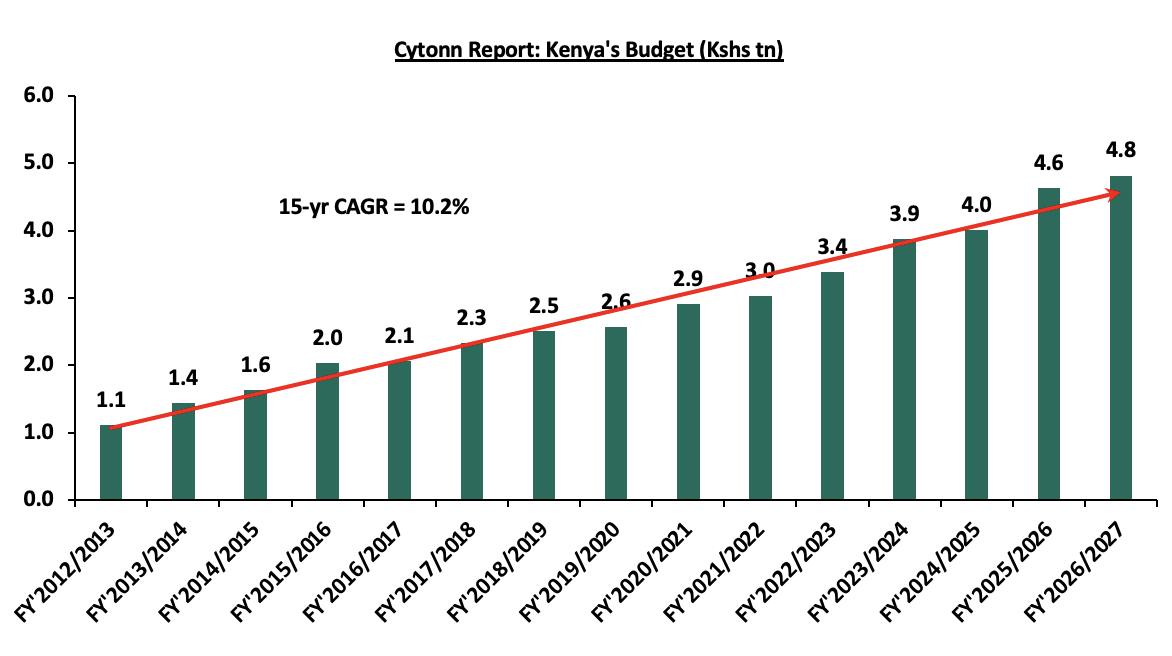
The Kenyan Government budget has been growing over the years on the back of increasing recurrent and development expenditures. The chart below shows the evolution of the government budget over a fifteen-year period:
Source: National Treasury of Kenya
For the FY’2026/2027, the budget is projected to increase by 3.9% to Kshs 4.8 tn, from Kshs 4.6 tn in FY’2025/2026 revised estimates. The expenditure will be funded by revenue collections and grants of Kshs 3.7 tn and borrowings amounting to Kshs 1.1 tn. The table below summarizes the key buckets and the projected changes:
|
Amounts in Kshs billions unless stated otherwise |
|||
|
Cytonn Report: Comparison between FY’2025/2026 and FY’2025/2026 Budgets Estimates |
|||
|
Item |
FY'2025/26 Revised Estimates |
FY'2026/27 Estimates |
Change y/y |
|
Ordinary Revenue |
2,784.4 |
2,985.7 |
7.2% |
|
Ministerial Appropriation-in-Aid |
619.8 |
644.8 |
4.0% |
|
Total grants |
34.8 |
43.6 |
25.3% |
|
Total Revenue & Grants |
3,439.0 |
3,674.1 |
6.8% |
|
National Government expenditure |
2,837.0 |
2,081.1 |
(26.6%) |
|
Consolidated Funds Services (CFS) |
1,366.6 |
1,501.3 |
9.9% |
|
Development expenditure |
831.1 |
809.0 |
(2.7%) |
|
County Transfer(Equitable share) & Contingencies |
415.0 |
429.0 |
3.4% |
|
Total expenditure |
4,638.4 |
4,820.4 |
3.9% |
|
Fiscal deficit inclusive of grants |
(1199.4) |
(1146.3) |
(4.4%) |
|
Projected Deficit as % of GDP |
(6.4%) |
(5.5%) |
(0.3%) pts |
|
Net foreign borrowing |
225.8 |
116.2 |
(48.5%) |
|
Net domestic borrowing |
973.6 |
1030.1 |
5.8% |
|
Total borrowing |
1199.4 |
1146.3 |
(4.4%) |
Source: National Treasury of Kenya, www.parliament.go.ke
Some of the key take-outs include;
- The government projects total revenue inclusive of grants for FY’2026/27 to increase by 6.8% to Kshs 3.7 tn (equivalent to 17.6% of GDP), from the Kshs 3.4 tn in FY’2025/2026 revised estimates (equivalent to 18.4% of GDP). The increase is mainly due to a 7.2% increase in ordinary revenue to Kshs 3.0 tn (equivalent to 14.3% of GDP) for FY’2026/2027, from the Kshs 2.8 tn in FY’2025/26 revised estimates (equivalent to 14.9% of GDP),
- Total expenditure is set to increase by 3.9% to Kshs 4.8 tn (equivalent to 23.2% of GDP), from Kshs 4.6 tn (equivalent to 24.9% of GDP) in the FY’2025/26 revised Budget estimates,
- National government expenditure is set to decrease by 26.6% to Kshs 2.1 tn (equivalent to 16.2% of GDP), in FY’2025/2026, from Kshs 2.8 tn in the FY’2025/2026 revised budget estimates. Consolidated Funds Services expenditure is set to increase by 9.9% to Kshs 1.5 tn in FY’2026/2027, from Kshs 1.3 tn in the FY’2025/2026 revised budget estimates. Also, Development expenditure is set to decrease by 2.7% to Kshs 809.0 bn, from Kshs 831.1 bn in the FY’2025/2026 revised budget estimates,
- Although the fiscal deficit is projected to decline by 4.4% to Kshs 1,146.3 bn in FY’2026/2027 from Kshs 1,199.4 bn in FY’2025/2026, the government remains heavily reliant on borrowing to finance its expenditure plans. With the total deficit expected be financed through domestic debt totaling Kshs 1,030.1 bn and foreign debts totaling Kshs 116.2 bn. Notably, Kenya’s public debt burden which stood at 2% of GDP as of March 2026, surpassing the 55.0% recommended threshold by 15.2% points, continues to exert pressure on fiscal sustainability and increase the risk of debt distress in the country, and,
- The budget deficit is projected to decline by 0.3% points to 5.5% of GDP, from the 6.4% of GDP in the FY’2025/2026 budget, mainly as growth in revenues outpace growth in expenditure.
Section III: Analysis and House-view on Key Aspects of the FY’2026/2027 Budget
- Revenue
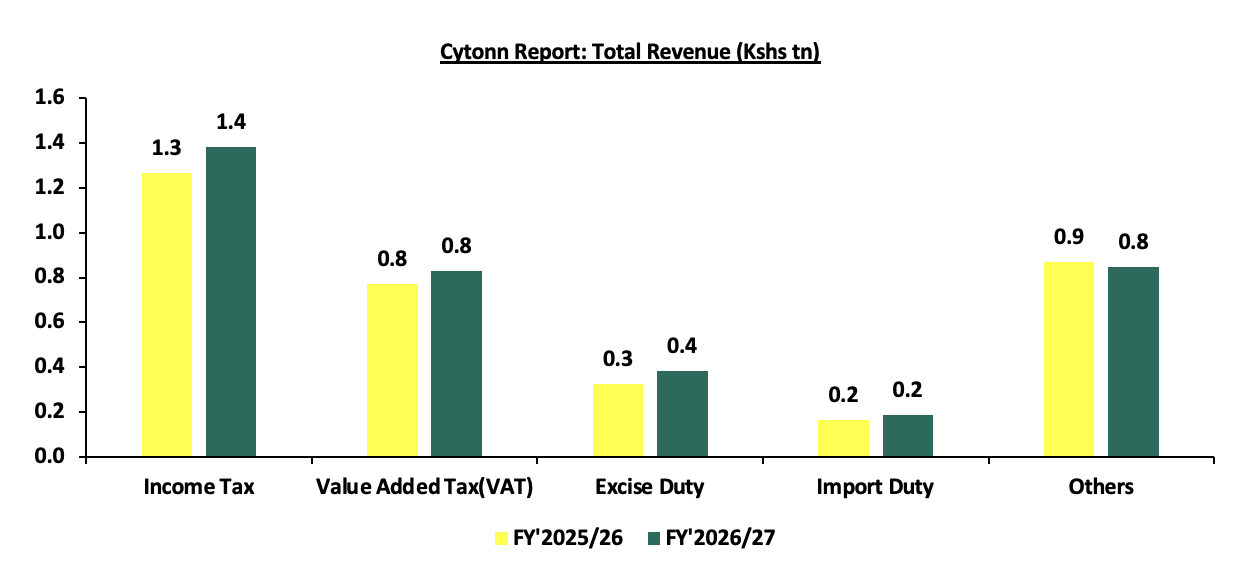
Revenue is projected to increase by 6.8% to Kshs 3.6 tn in FY’2025/26, from Kshs 3.4 tn in the FY’2025/26 supplementary budget. The increased revenue projections in the FY’2026/27 are mainly attributable to the projected 7.2% growth in ordinary revenue to Kshs 3.0 tn in FY’2026/27, from Kshs 2.8 tn in the FY’2025/26 budget. The main sources of revenue will be:
- Income Tax, which remains the highest contributor to government revenue, contributing 38.1% of the total revenue projections of Kshs 3.6 tn, is expected to increase by 9.2% to Kshs 1.4 tn in FY’2026/27, from Kshs 1.3 tn in FY’2025/2026,
- Value Added Tax (VAT) contributing 22.8% of the projected total revenue is projected to increase by 7.5% to Kshs 829.2 bn in FY’2026/27 budget, from Kshs 771.7 bn in the FY’2025/26 budget,
- Excise Duty contributing 10.6% to the projected revenues for the FY’2026/27 is expected to increase by 18.1% to Kshs 383.4 bn, from Kshs 324.6 bn in FY’2025/26 supplementary budget estimates, and,
- Import Duty contributing 5.1% to the projected revenues for the FY’2026/27 is expected to increase by 11.5% to Kshs 186.2 bn, from Kshs 167.0 bn in FY’2025/26 supplementary budget estimates.
The chart below compares ordinary revenue projections for FY’2026/27 and FY’2025/26:
Source: National Treasury
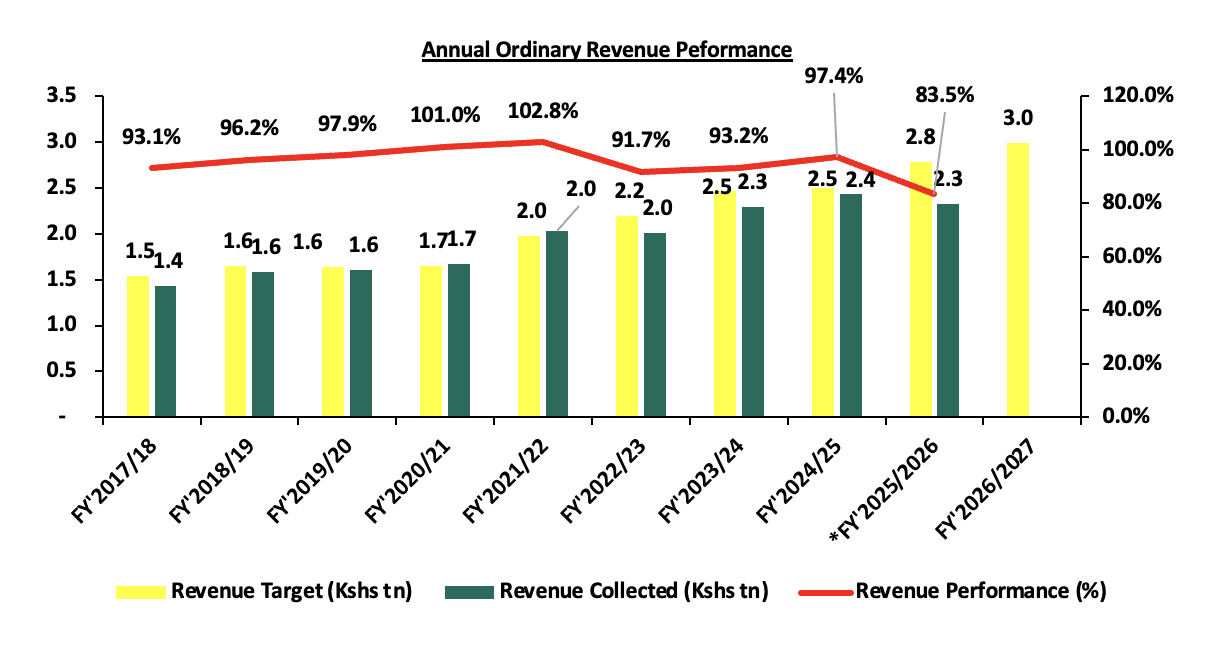
The government relies on the effectiveness of the Kenya Revenue Authority (KRA) in collecting taxes, as well as enhancements to existing tax measures, to meet its revenue targets. This strategy has seemingly resulted in improved revenue collection, as evidenced by the attainment of 97.4% of the revenue target in FY'2024/25 and 91.1% of the prorated revenue target for FY'2025/26 as of May 2026. To support the FY'2026/27 revenue target of Kshs 3.6 tn, the government intends to enhance domestic resource mobilization through the continued implementation of the National Tax Policy and the Medium-Term Revenue Strategy. Key measures include broadening the tax base, deepening tax administration reforms through technology, strengthening customs valuation, sealing revenue leakages, and enhancing the collection of non-tax revenues from government agencies. These initiatives are expected to improve tax compliance, increase efficiency in revenue administration, and reduce reliance on external financing.
However, despite these efforts, the government has historically struggled to consistently meet its revenue collection targets, resulting in persistent fiscal deficits and increased borrowing requirements. As such, concerns remain regarding the government's ability to achieve its FY'2026/27 revenue target, particularly against the backdrop of a challenging operating environment characterized by elevated living costs, with inflation standing at 6.7% in May 2026. Additionally, the ambitious revenue growth assumptions, coupled with potential tax compliance challenges and slower than expected economic activity, could weigh on revenue performance. External risks also remain elevated, with the recent Iran-Israel-USA conflict underscoring the susceptibility of global supply chains and energy markets to geopolitical shocks. While the ceasefire agreement has helped alleviate immediate concerns over supply disruptions and escalating oil prices, geopolitical tensions in the region remain elevated, leaving global markets vulnerable to renewed uncertainty. As such, any resurgence in hostilities could trigger higher global oil prices, heighten inflationary pressures, increase production and transportation costs, dampen consumer spending and economic activity, and ultimately constrain revenue collection, increasing the likelihood of additional borrowing to finance government expenditure. The chart below shows the ordinary revenue performance in the previous fiscal years:
Source: National Treasury of Kenya and Kenya Revenue Authority
*Total Revenue collection as of 31 May 2026
- Expenditure
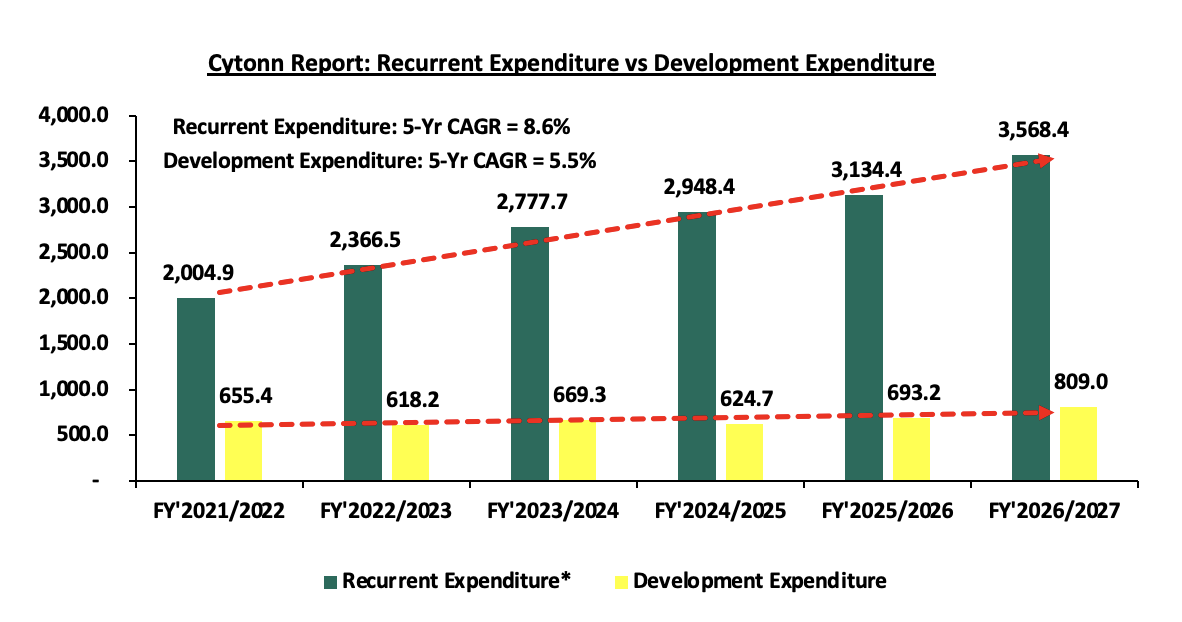
Expenditure is expected to increase by 3.9% to Kshs 4.8 tn, from Kshs 4.6 tn in the FY’2025/26 revised budget with recurrent expenditure taking up 74.0% of the total expenditure for FY’2026/2027, in comparison to the 73.0% in FY’2025/2026. The chart below shows the comparison between the recurrent expenditure allocations and development expenditure allocations over the past five fiscal years:
Source: National Treasury of Kenya
*Recurrent Expenditure includes the Consolidated Fund Services (CFS) Expenditure
Some of the key take-outs include;
- Recurrent expenditure takes the largest proportion of government expenditure over the last five fiscal years growing at a 5-year CAGR of 8.6% to Kshs 3,568.4 bn in FY’2026/27, from Kshs 2,366.5 bn in FY’2022/2023. For the FY’2026/2027, the recurrent expenditure is estimated to increase by 13.8% to Kshs 3,568.4 bn, from Kshs 3,134.4 bn in FY’2025/2026 mainly due to a 9.9% increase in Consolidated Fund Services (CFS) expenditure to Kshs 1,501.3 bn from Kshs 1,366.6 bn in FY’2025/2026 revised estimates. The increase can be mainly attributed to the increased debt servicing cost which represented 91.2% of the CFS expenditure in FY’2025/2026 as of 30th May 2026. We expect the debt servicing cost to continue increasing as the government is expected to borrow more to close the revenue gap, and,
- Development expenditure on the other hand continues to lag behind contributing only 16.8% of the FY’2026/27 expenditure estimates. Allocation to infrastructure remains the highest taking 75.7% of the development expenditure. In the FY’2026/2027, infrastructure expenditure is set to decrease marginally by 0.8% to Kshs 531.3 bn, from Kshs 535.3 bn estimate in FY’2025/2026 in line with the government’s agenda of increasing the development of critical infrastructure in the road, rail, sea, and airport sectors in order to open many areas to economic activities and spur growth in cross border trade and regional integration. The table below shows the sectors with the highest expenditure allocation over the last five fiscal years:
|
Amounts in Kshs billions unless stated otherwise |
||||||||
|
Cytonn Report: Kenya Budget Highest Expenditure Allocations |
||||||||
|
Item |
FY'2022/2023 |
FY'2023/2024 |
FY'2024/2025 |
FY'2025/2026 |
FY'2026/2027 |
Change (FY2026/27 and FY2025/26) |
5-year CAGR |
|
|
Interest Payments, Pensions & Net Lending |
867.8 |
1057.7 |
1242.7 |
1337.0 |
1501.3 |
12.3% |
11.6% |
|
|
Education |
544.4 |
628.6 |
656.6 |
659.8 |
784.5 |
18.9% |
7.6% |
|
|
Infrastructure |
416.4 |
468.2 |
477.2 |
535.6 |
531.3 |
(0.8%) |
5.0% |
|
|
County Shareable Revenue |
399.6 |
423.9 |
445.6 |
474.9 |
502.0 |
5.7% |
4.7% |
|
|
Public Admin & Int. Relations |
342.2 |
327.0 |
322.4 |
335.4 |
373.7 |
11.4% |
1.8% |
|
|
Total |
2570.4 |
2905.4 |
3144.5 |
3342.7 |
3692.8 |
10.5% |
7.5% |
|
Source: The Mwananchi Guide for the FY’2026/27, National Treasury of Kenya
Notably, the allocation to interest payment, pension and net lending increased by 12.3% to Kshs 1,501.3 bn in FY’2026/27 from Kshs 1,337.0 bn in FY’2025/26, partly attributable to high cost of servicing debt.
- Borrowing
The total borrowing for the FY’2026/27 is set to decrease by 4.4% to Kshs 1,146.3 bn, from Kshs 1,199.4 bn, in FY’2025/26 revised budget estimates. The public debt mix is projected to comprise of 10.1% foreign debt and 89.9% domestic debt, from 18.8% foreign financing and 81.2% domestic financing as per the FY’2025/26 revised Budget estimates. The rise in debt servicing expenses can be partly attributed to the government’s high affinity for debt to finance the wide budget deficits, partly fueled by the ballooning recurrent expenditure and debt costs. As the government works towards maintaining sustainable debt levels, it will be crucial to implement debt management reforms, prioritize concessional borrowing, and develop the domestic debt market to lower borrowing costs further. Additionally, the government will explore innovative financing options such as debt swaps, diaspora bonds, and sustainability-linked instruments to diversify funding sources, and support fiscal consolidation. The chart below shows the evolution of public borrowing to fill the fiscal deficit gap over the last five years:
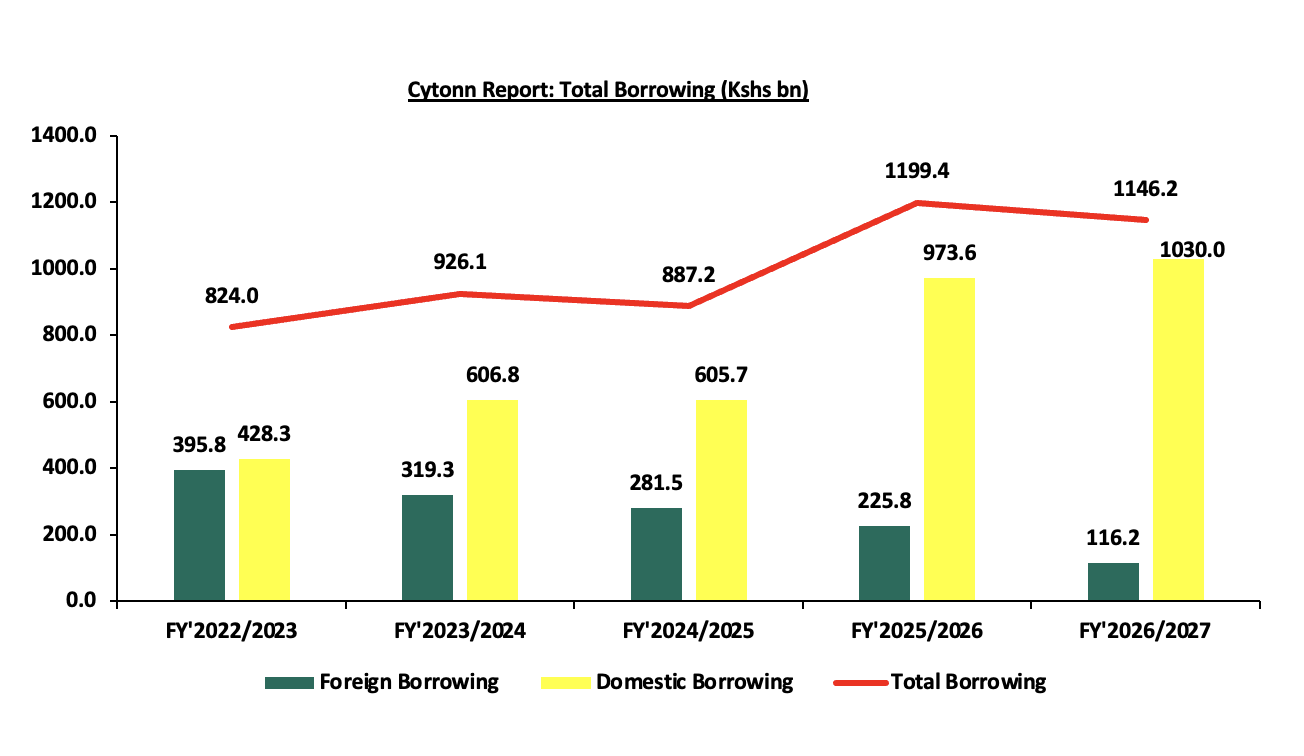
The key take-outs from the chart include:
- The proportion of domestic financing is estimated to rise to 89.9% in FY’2026/27 from 81.2% in FY’2025/26. While this may heighten the risk of crowding out the private sector given banks' preference for lending to the government due to lower perceived risk, it is worth noting that yields on government securities had generally been on a downward trajectory following the Central Bank of Kenya's monetary policy easing cycle. However, yields have recently begun to edge upwards, with the average yield on the 91-day Treasury Bill increasing to 8.6% in June 2026 from 8.2% in June 2025, partly reflecting rising inflationary pressures and the Monetary Policy Committee's decision to maintain the Central Bank Rate at 8.75%, signalling a pause in the easing cycle. If sustained, the increase in yields could raise borrowing costs and exert pressure on private sector access to credit, and,
- The total borrowing is expected to decrease by 4.4% to Kshs 1,146.2 bn, from Kshs 1,199.4 bn in FY’2025/26 revised estimates, reflecting the dependence on debt to finance the fiscal deficit. This underscores the need for sustained fiscal consolidation efforts, including enhanced revenue mobilization and prudent expenditure management, to reduce long-term debt dependence and ensure fiscal sustainability.
We therefore note the persistent fiscal deficit is mainly on the back of low revenue collection and high expenditure. As such, the government needs to minimize spending through the implementation of structural reforms and the reduction of amounts extended to recurrent expenditure. This would allow the government to refinance other critical sectors, such as agriculture, resulting in increased revenue.
Section IV: Finance Act 2026
On 18th June 2026, the Kenyan Parliament approved the Finance Bill 2026. On 23rd June 2026 the president assented the bill into law (Finance Act 2026), with its provisions set to take effect from 1st July 2026. Rather than introducing aggressive tax hikes, the Finance Act focuses on plugging revenue leakages. The raft of tax changes in the Finance Act 2026 are geared towards expanding the tax base and increasing revenues through sealing revenue leakages to meet the government’s budget for the fiscal year 2026/2027 of Kshs 4.8 tn, as well as reduce the budget deficit and borrowing.
Against this backdrop of fiscal consolidation and cautious borrowing, the Finance Act 2026 introduces a series of targeted measures that aim to broaden the tax base, seal revenue leakages, and support the government’s drive toward a more sustainable fiscal framework. Below we highlight some of the key tax changes, effective from 1st July 2026 contained in the Finance Act 2026 and the implications:
a) Under the Income Tax Act, the Act provides:
- A tax amnesty on penalties and interest for tax liabilities relating to periods up to 31st December 2025, provided the principal tax is paid by 31st December 2026. This is expected to encourage settlement of outstanding tax obligations, improve voluntary compliance, and enhance revenue collection without increasing tax rates.
- A 1.5% withholding tax on the sale of scrap metal, expanding the tax net into sectors perceived to have historically low compliance levels while improving traceability of transactions within the scrap metal value chain.
- A withholding tax on interchange fees and merchant service fees arising from card payment transactions. This effectively brings Visa, Mastercard, and other card-processing related payments into the withholding tax framework, broadening the tax base within the financial services ecosystem.
- A 20.0% withholding tax on winnings from gambling activities, enhancing taxation within the betting sector and increasing revenue collection from gaming-related transactions.
- Clariification the definition of immovable property by separating land-related interests from mining and petroleum rights, reducing ambiguity in tax interpretation and strengthening legal clarity in taxation of extractive and property-related transactions.
- Expansion the scope of withholding tax to selected digital and platform-based transactions, enhancing monitoring and taxation of the digital economy while increasing compliance obligations for digital service providers.
- Introduction of measures aimed at strengthening enforcement of tax compliance among informal sector participants and hard-to-tax sectors, supporting the government’s broader revenue mobilization agenda.
b) Under the Excise Duty Act, the Act provides:
- A 50.0% excise duty on antique and vintage motor vehicles that are at least thirty years old. This proposal is expected to target luxury and collector assets, significantly raising the cost of acquiring and importing historic automobiles into the country, while also expanding government revenue collection from high-net-worth hobbyists and the luxury automotive sector.
- A detailed definition of “amount deposited” for purposes of betting and gambling excise duty to include money, cash equivalents, tokens, credits, and similar instruments used in gambling transactions. This broadens the excise duty base by capturing alternative forms of value used in betting and gaming platforms, reducing loopholes within digital gambling ecosystems.
- Introduction of definitions for “virtual asset” and “virtual asset service provider” by linking them to the Virtual Asset Service Providers Act, 2025. This aligns the Excise Duty Act with the emerging digital asset regulatory framework and strengthens the government’s ability to tax virtual asset-related transactions.
- Extend excise duty exemptions to goods imported or acquired for official use by the National Intelligence Service (NIS), including machinery, equipment, supplies, and motor vehicles. This lowers procurement costs for strategic national security operations.
- Introduce excise duty measures targeting selected digital and technology-related transactions, reflecting the government’s continued shift toward taxation of emerging digital economic activities.
c) Under the Value Added Tax (VAT) Act, the Act provides:
- Exemption of scrap metal from VAT, reducing input costs for recyclers and manufacturers dependent on recycled raw materials while potentially formalizing activity within the recycling sector.
- Exemptions of inputs and raw materials used in the manufacture of animal feeds and pharmaceutical products from VAT, lowering production costs for manufacturers and potentially supporting affordability within the agriculture and healthcare sectors.
- Exemption of dialyzers used in kidney treatment from VAT, reducing treatment costs for dialysis patients and improving affordability of renal healthcare services.
- Exemption of goods and services used in public-private partnership infrastructure projects from VAT subject to approval by the Cabinet Secretary, lowering project costs and potentially encouraging private sector participation in infrastructure development.
- Introduction of VAT on selected digital and platform-based financial services, broadening taxation within the digital economy and increasing the tax burden on fintech and platform-based financial service providers.
- VAT relief on selected renewable energy and electric mobility products including electric buses and bicycles, supporting the government’s transition toward green mobility and clean energy adoption.
- Expands VAT administration and compliance measures aimed at strengthening revenue collection efficiency and reducing tax leakages within the VAT framework.
d) Under the Tax Procedures Act, the Act provides:
- Reduction the income tax return filing period from six months to four months ( 30th April) for individuals while requiring corporations to file returns by 30th June accelerates compliance timelines and enhances the Kenya Revenue Authority’s ability to reconcile taxes earlier; however, this shift may increase compliance pressure for businesses managing complex reporting structures under tighter deadlines.
- A tax amnesty programme on penalties and interest for liabilities accrued up to 31st December 2025, provided principal taxes are settled by 31st December 2026. This is expected to improve voluntary compliance, encourage settlement of historical tax liabilities, and support short-term revenue collection.
- Introduction of a requirement for Virtual Asset Service Providers (VASPs) to file an annual information return with the Commissioner in respect of all virtual asset transactions involving reportable users or those with controlling persons. The information return applies where a VASP provides exchange transaction services or makes available a trading platform on behalf of a customer, including where it acts as a counterparty or intermediary. The Act further empowers the Government to enter into agreements with other countries for the automatic exchange of information relating to virtual asset transactions, strengthening cross-border tax transparency and increasing compliance obligations for digital asset businesses operating in or from Kenya
e) Key Proposals Dropped or Amended During Parliamentary Deliberations
During the legislative process, several provisions contained in the Finance Bill, 2026 faced significant opposition from Members of Parliament and stakeholders, resulting in their rejection or amendment before the Bill was enacted into law. Key proposals that were dropped include:
- The proposed increase in the Residential Rental Income Tax rate from 7.5% to 10.0% was withdrawn. The proposal would have reversed a reduction introduced under the Finance Act, 2023, which lowered the rate from 10.0% to 7.5% to encourage compliance among residential landlords. Legislators opposed the proposal on the grounds that it would increase the tax burden on landlords without addressing the compliance challenges that necessitated the earlier reduction.
- The proposed introduction of a 25.0% excise duty on all mobile phones activated in Kenya, whether imported or locally manufactured, was removed. While the National Treasury argued that the measure would simplify taxation by replacing multiple levies with a single consolidated charge, Parliament found the activation-based collection mechanism impractical and likely to create compliance challenges, implementation delays, and uncertainty for consumers.
- The proposal to empower the Kenya Revenue Authority (KRA) to issue agency notices despite ongoing tax disputes, objections, or court proceedings was rejected. Legislators argued that the measure would undermine taxpayers' rights to fair administrative action and could adversely affect business cash flows and operations.
- The proposal to calculate timelines for filing tax objections and appeals using calendar days instead of working days was also dropped. Parliament maintained that including weekends and public holidays in statutory timelines would significantly reduce the effective period available to taxpayers to comply with procedural requirements.
- The proposed introduction of a deemed dividend tax requiring companies to distribute at least 60.0% of undistributed income as dividends was rejected following strong opposition from the private sector. Stakeholders argued that the measure would limit the ability of businesses to retain earnings for reinvestment, expansion, and working capital needs, potentially constraining private sector growth and investment.
The Finance Act 2026 reflects the government’s continued preference for administrative revenue mobilization and compliance enhancement as opposed to politically sensitive broad-based tax increases. The proposals place significant emphasis on expanding withholding tax coverage, tightening filing and enforcement timelines, enhancing taxation of digital and informal sector transactions, and improving the efficiency of tax collection within the existing framework. This approach is likely informed by the need to sustain fiscal consolidation efforts while minimizing the political and economic disruption associated with aggressive tax hikes.
The Act comes at a time when the government seeks to strengthen domestic revenue mobilization amid elevated debt servicing obligations and constrained fiscal space. While inflation currently at 6.7% as of May 2026 well within the CBK’s target range of 2.5%-7.5%, inflationary pressures still remain, particularly from the potential pass-through effects of new tax measures, exchange rate movements, geopolitical tensions and food and energy price volatility. At the same time, the Central Bank of Kenya's decision to maintain the Central Bank Rate (CBR) at 8.75% in June 2026 is expected to sustain favorable credit conditions, support private sector activity, and underpin economic growth. As such, the effectiveness of the Finance Act, 2026 will depend not only on the successful implementation of its revenue measures and improved taxpayer compliance, but also on prudent expenditure management and fiscal discipline. Going forward, achieving a sustainable fiscal position will require a balanced approach that enhances revenue collection, contains expenditure growth, supports economic activity, and preserves macroeconomic stability.
Section V: Conclusion and Our View
The Kenyan economy has continued to remain resilient despite recording a slowdown in growth to 4.6% in FY’2025 compared to a growth of 4.7% recorded in FY’2024. We expect the economic activity to remain resilient given the improved business environment as result of the declining cost of credit providing some relief to businesses and households. Additionally, the Central Bank of Kenya's Monetary Policy Committee (MPC) maintained the Central Bank Rate (CBR) at 8.75% during its meeting on 10th June 2026, the same level maintained in April 2026, in a bid to support economic growth while sustaining price and exchange rate stability. The accommodative monetary policy stance is expected to support credit growth and sustain lower borrowing costs, hence encouraging borrowing, which will in turn lead to increased investment spending in the economy by both individuals and businesses. Moreover, the economy is expected to record a growth rate of 4.7% in 2026, mainly supported by private sector growth, continued strong growth of the financial services sector, and recoveries in the agricultural sector. Furthermore, in the FY’2026/2027 budget, the government has allocated Kshs 18.0 bn for the fertilizer subsidy program aimed at lowering the cost of farm input and enhancing food supply in the country.
The government has sustained its appetite for debt, projecting to borrow Kshs 1,146.2 bn in total debt in the FY’2026/27, albeit a 4.4% marginal decrease from 1,199.4 bn in the FY’2025/26. The move is expected to increase the cost of debt servicing, given that both foreign and domestic debt has been ballooning as a result of wide budget deficits. Additionally, with the government's continued inclination towards domestic borrowing, by projecting to increase its domestic borrowing by 5.8% to Kshs 1030.1 bn in FY’2026/27, from Kshs 973.6 bn in FY’2025/26, remains a risk to private sector credit growth, with increased competition by the government in the absence of alternative borrowing.
Overall, we are of the view that the main driver of the growing public debt is the fiscal deficit occasioned by expenditures consistently outpacing revenues. As a result, implementing robust fiscal consolidation would help the government bridge the deficit gap and improve debt sustainability. This can be achieved through expenditure rationalization, implementation of structural reforms, and reducing the share of recurrent expenditure. Fiscal consolidation would also create fiscal space for increased investment in productive sectors such as agriculture, thereby supporting economic growth and enhancing revenue generation. However, the overall risk to the economy remains elevated, owing to the high debt servicing costs in the next fiscal year.
Disclaimer: The views expressed in this publication are those of the writers where particulars are not warranted. This publication, which is in compliance with Section 2 of the Capital Markets Authority Act Cap 485A, is meant for general information only and is not a warranty, representation, advice or solicitation of any nature. Readers are advised in all circumstances to seek the advice of a registered investment advisor.

- Talk to us
- Kenya
- P.O Box 20695 - 00200, Nairobi, Kenya
- Cell +254709101200
- Tel +254709101200
- WhatsApp +254741676635
- United States
- +254709101200
- DOWNLOAD OUR APP
-


- Kenya
- 8th Floor, Pinetree Plaza, Kaburu Drive, Ngong Road, Nairobi, Kenya
- USA
- Suite 1150, 1775 Eye Street NW, USA, Washington DC 20006, USA
- Investments
- High Yield
- Private Equity
- Real Estate
- Real Estate
- RiverRun Estates
- Cytonn Towers
- The Ridge
- Taraji Heights
- The Alma